Scenario Planner · Module I
Decide it once.
With the whole
team behind it.
Before FID, your team takes a position whether it means to or not — across seats, templates, and inherited assumptions. Scenario Planner makes it conscious: what the asset carries, what it transfers, what the RFQ enforces — every stance priced, every tension on the table, the agreement dated.
The Lifecycle Posture Map · four readings of one asset · illustrative
Module I of III
Part of Storinum GRID, the decision platform for energy assets. Your team runs it themselves, on its own schedule. Everything decided here carries forward into Procurement and Resolve.
The position gets taken either way.
Here, your team takes it on purpose.
Every big call is value versus risk. Value is what the asset earns against what it costs to build, run and replace. Risk is what you carry against what you transfer. Scenario Planner prices all of it before you commit.
You design the investment decision.
Not a spec sheet. The decision itself.
From there, every detail aligns against two things and two only — the life the asset has to live, and the risk posture you hold it to.
Chemistry. Warranty terms. Retention. Precedence. Cycling. Around twenty calls that look technical — and are all, underneath, one question:
What do you carry, and what does a contractor carry?
Twenty scattered opinions stop being scattered. They become one position — priced, dated, ready to procure against.
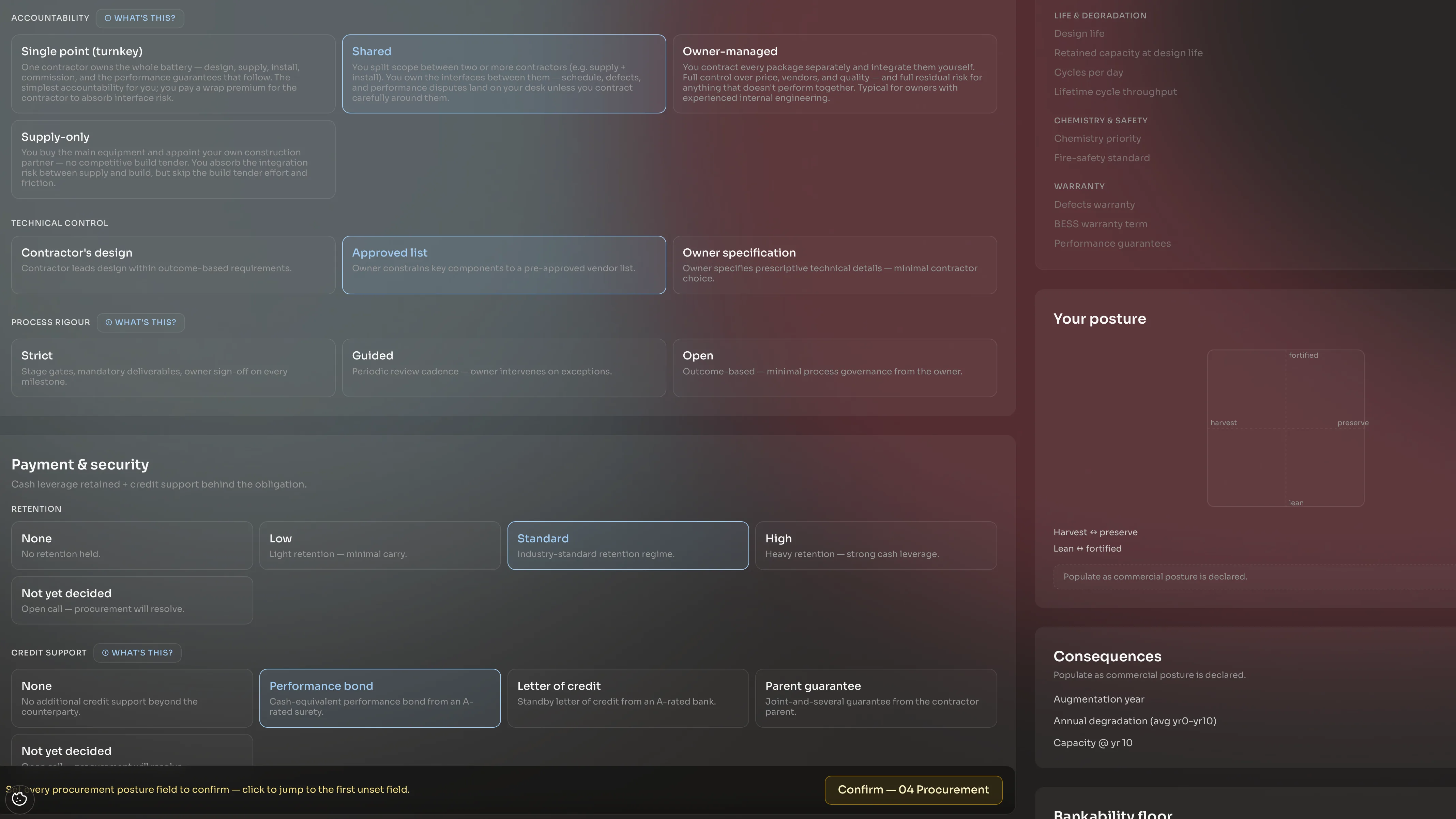
Every option states both sides on its face: what it buys you, and what it costs you. Nothing here is a checkbox.
You choose.
We show.
One decision, end to end.
Warranty depth, as Scenario Planner puts it to you — three of the options, in outline. Pick one: the consequences land as you choose. Illustrative.
With this choice
The call is yours. Nothing is recorded as chosen until you choose it.
How a decision gets made here.
The card, in plain language
Three or four options, each with its gain and its trade written out — the choice as it actually is, in the words you would use to explain it.
The consequences compute, live
The position moves on the map. A tension flag lights where this choice pulls against another. The bankability floor updates, a directional cost band appears, the degradation outlook redraws against the life you set.
Your context lands beside it
Drag in the TDD report, the grid offer, your own view of the future — it sits next to the decisions it informs. Your view of the market is yours to bring.
You can overrule the machine
Every calculation is editable. Read the situation differently and your reading wins — the position recomputes from it.
"Decide later" is a real answer
It becomes an open item with an owner and a deadline, and it stays visibly open until someone answers it. Only the decisions your team actually made end up on the record.
Sign off
The agreed position becomes a dated, attributed record — the single source every document and every module reads from afterwards.
What leaves the room.
One position, three documents: the investment brief, the technical brief, the RFQ. Each is generated from the same rows, filtered by audience — so they agree by construction, and each reader gets what belongs to them.
For the board, the fund, the lender
The investment brief
The position, its price, and the risks it places. Returns run on your forecast — your numbers, our arithmetic, the provenance readable at a glance. Your board doesn't need our IRR. It needs to know the IRR your own team produced assumed a warranty the market won't sell.
For the engineer
The technical brief
The design-stage requirements, the site context you actually hold — and the rest named as unknowns for the survey to close. An empty field isn't a gap in the document; it's an instruction to the person whose job it is to close it, with the reason it's open. The brief is the survey scope.
For the vendor
The RFQ
Structured from the decisions, scoped to the route you chose — the ask matched to who is actually responsible for answering it.
Into tender: Round 0.
The signed-off position generates the RFQ draft automatically — Round 0 of Procurement, born from the posture. Edit it freely; every edit is read back against the position, so nothing drifts between what you decided and what you asked for. Change the draft, and the position moves with it — shown, priced, yours to confirm.
Once it's signed off, it becomes the baseline everything lives against.
The moment your team agrees, the position locks into the record — dated, attributed, unchanged until you change it on purpose. From then on it isn't a document. It's the reference. Every decision and every event that follows gets read against it, for as long as the asset runs.
This is why the session matters. With a position on record, every offer in Procurement is measured against it, and Resolve spends twenty years testing reality against it — each gap traced, each move priced. Without one, later decisions get argued from memory and preference.
The baseline moves when you move it.
A strategy shift or a market re-pricing changes what the asset is held to — and the position is signed off again against the new plan, with the change on the record. Coming off plan becomes a decision your team makes, on a date, for a reason.
What changes on Monday.
Whichever seat you sit in — the one signing, or the one who has to make the numbers hold up.
Walk into committee armoured
Every figure carries its source. When someone asks where a number came from, the answer is a click and a clause — not a promise to check.
The hard thing gets said early
A tension between two choices surfaces the moment it exists, priced, on the table. It stops being a thing anyone has to raise at the wrong moment — and starts being a thing the room solves together.
The night before committee day, gone
The briefs generate from the decisions. What's left is the part worth staying up for: the judgment, the argument, the call.
Already out to tender?
Send the package. Scenario Planner reads back the position you have already taken — every line tagged by how it was obtained, every line correctable, and the position recomputes from each correction. Proven on a live two-site, 600 MWh tender from published documents alone: the strongest warranty in the catalogue, specified in one clause and outranked in another — and six of seven material risks priced to the owner.
Before FID is the cheapest moment to decide well.
Bring a live project — and bring the seats: technical, legal, commercial. Typically one working session, focused on your stage.