Storinum GRID · Procurement
Suppliers present price.
You see what it costs you.
Your RFQ is a statement of what you're willing to carry — and what you're paying suppliers to take off your hands. Every offer that comes back is a quiet counter-proposal on that same question — and it never arrives labelled as risk. It arrives as a lower number.
Procurement finds the difference, prices it in euros, and hands you the clause to push on.
Round 2 · three offers, same scope basis · illustrative
Vendor C quoted lowest. The gaps under the price cost €340k — and every one of them lands on you.
Module II of III
Part of Storinum GRID, the decision platform for energy assets. You run the evaluation yourself, on your RFQ, with your suppliers. Used with the Strategic Posture Planner, the RFQ arrives already built from the position your team agreed.
The lowest quote wins the meeting.
The gaps under it decide the next fifteen years.
Price the field yourself.
Three offers on the same asset. Pick one — every gap between what you asked for and what you're being offered, priced, with the clause it comes from. Illustrative.
What sits under the headline price
Total gap
You decided what to carry.
Here is where the market hands it back.
Your RFQ took a position — this much protection, this much exposure, this life, this duty — whether it was written deliberately or inherited from the last tender.
Every offer that comes back answers that question differently — and never says so out loud:
Component-only warranty — you carry the labour, from day one
No milestone structure — you carry the delay, with no counterparty
Referenced items unpriced — you carry the change orders, at full rate
No commissioning baseline — you carry the degradation you thought you transferred
So there is one question to ask of every offer, in every round:
Does this hand me back something I decided to transfer?
Push it back with the clause in hand, or take it knowingly and priced. Either way it's a decision — and what you sign is the position you actually chose, not the one that quietly eroded between the RFQ and the pen.
Not sure what you are willing to carry?
That is the question the Strategic Posture Planner answers. Your team agrees which risks you take and which you pay to transfer — before procurement begins — and the RFQ arrives already built from that position. Optional: Procurement runs on the RFQ you already have.
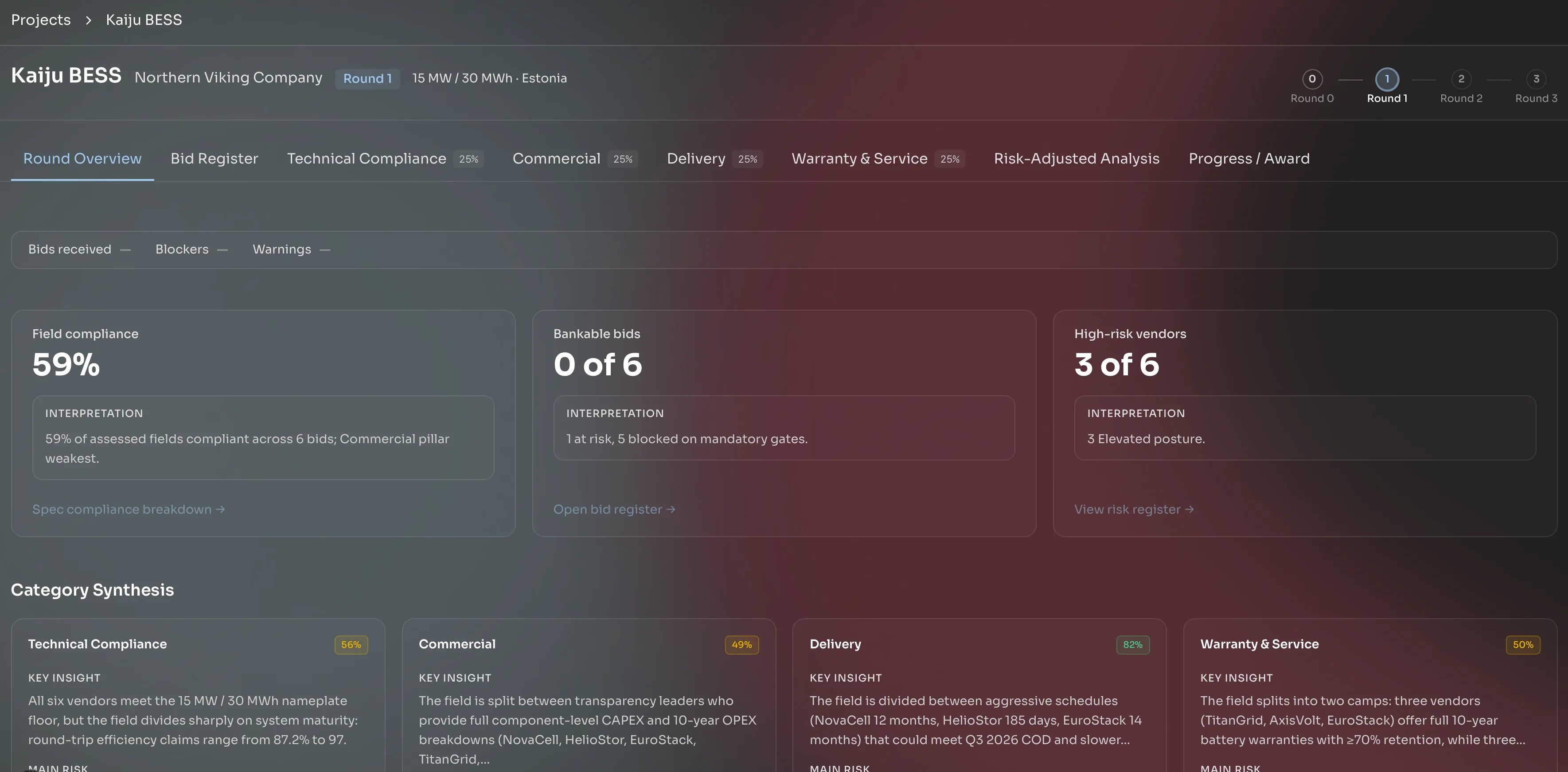
Every flag traces to a clause and a page. When someone asks where a number came from, the answer is a click.
Closing the gap.
A risk score is not a rejection. It is a negotiation map.
Four ways an offer moves risk onto your desk.
Every proposal is read on four dimensions — and each one asks the same question in a different language: what does this quietly move onto your side of the line?
Commercial
Headline capex isn't comparable — every supplier scopes differently. Offers are normalised to one scope basis, referenced-but-unpriced items flagged, payment structure and exposure compared. You read equivalent prices, not whatever each supplier chose to include.
what's in the price — and what isn't
Technical
Suppliers propose what fits their portfolio. Each configuration is scored against your duty — cycles, depth of discharge, degradation trajectory — not a generic checklist, and every curve is compared under the same assumptions.
fit for your asset, not their range
Warranty
Component-only coverage looks equivalent to full coverage until the first service event. Labour and mobilisation scope scored per offer, enforceability conditions flagged, warranty value made comparable across the field.
cover on paper vs protection in practice
Delivery
Almost every contract has penalties. The question is whether the milestone structure is defined clearly enough to trigger them — because vague milestones mean the delay belongs to nobody, and defaults to you.
who carries the slip
The four dimensions are the easy part. What they do to each other is the work.
A longer warranty term with a weaker LD regime. A better price against a payment schedule that removes your leverage. A technical spec that only one bidder can meet, on delivery terms nobody checked. The gaps sit between the dimensions, and no one can hold four documents open at once and see them. The trade-off engine reads every combination and shows what moves when you move one thing — so your team spends the meeting deciding, instead of discovering.
Four engines, reading every page you don't have time to.
Running across every offer, in every round, while you do the part that needs judgment. They do the reading. You make the calls.
Risk premium engine
Turns every contractual gap into a number on the supplier's headline price. The ranking you read is by total cost of ownership — not by who quoted lowest.
Trade-off engine
Move one variable and watch what moves across the others — before any of it is a commitment.
Negotiation engine
Supplier-specific angles per round, ranked by financial impact, each with the contractual basis for the ask. You know what to push on before the conversation starts.
Contradiction, enforceability & bankability checks
Every offer read against itself, so clauses that cancel each other out surface before signing. Every protection tested for whether it could actually be claimed. Every package checked against what a lender will want at refinancing — while the gap is still closeable.
Your vendors. Your list. Always.
You invite the suppliers you want — the ones you have worked with, the ones your team trusts — or ones matched from GRID's pre-qualified network. Your list, your call, every time.
You run it. Nothing moves without you.
From your RFQ to your signature — four steps, and you are the one holding the pen at every one of them.
1 · Your RFQ
Bring your own format, build one here, or generate it from your planner position. You choose the vendors — send through the platform, or download the PDF and send it yourself.
2 · Upload the proposals
One folder per vendor, as they arrive. Every proposal is read against your requirements and the gaps priced. You will be notified when results are ready.
3 · Review with the source in hand
Every data point shows where in the document it came from; low-confidence reads are flagged for you to confirm or correct before they count.
4 · Respond
Feedback and questions per supplier, prepared for you. You edit, approve, send — nothing reaches a supplier without your review.
Three rounds, and the leverage stays with you.
Nothing here waits on us — no queue behind an analyst, no weeks lost normalising documents by hand. The pace is yours and your suppliers'.
Round 1
The field, made comparable
Every offer normalised to one scope basis and read on four dimensions. The gap register comes out, the premium lands per offer, the ranking is by true cost. Every supplier gets specific, dimension-level feedback — which is what makes the next round tighter.
Round 2
The field, compressed
The weakest are out, with the basis on record. The rest get targeted revision requests. Price spread narrows; gaps either close or turn into priced exposure you can decide about.
Round 3
The decision
Differences known, quantified, ranked by financial impact. A pre-signing list: every open flag resolved or accepted on purpose. The award, with the trail underneath every number — and the record passes to Resolve.
Round 0, if you came from the planner:
The RFQ generates from the frozen position you agreed in the planner. Edit it freely — every edit reads back against the position, so nothing drifts between what you decided and what you asked for.
What changes on Monday.
Whichever seat you sit in — the one signing, or the one who has to make the field comparable by Thursday.
The award defends itself
Every number in the recommendation traces to a document, a clause, and a round. The audit trail exists because the work was done in it — not assembled the week IC asks.
The leverage stays on your side
Gaps get found while there's still competition in the room. After award, the pressure is gone and the price is whatever the change order says.
No more manual normalisation
The field arrives comparable. What's left is the part worth the time: what to push on, what to accept, and who wins.
Bring a live RFQ.
Your structure, your shortlist — we run a session on your real field: gaps surfaced, true cost priced, negotiation angles on the table. Your RFQ structure stays confidential.