The position
What you carry, priced
Each decision resolved with a number on both sides: what stays with you, what moves to a contractor, and what that costs either way.
Pricing
Start free on an RFQ you already have. After that you pay per round, for the vendors actually in it. Running it continuously across everything you hold is a different conversation, and we size that with you.
Priced per project
Two of these are bought one project at a time. The third runs continuously across everything you hold.
Strategic Posture Planner
Decide what you carry, what you transfer, and make the RFQ enforce it.
Every option shows its gain and its trade on the face of it. You choose, and the consequence computes: the position moves, the cost band updates, and where two of your own answers pull apart it says so with a price. Precedence, liquidated damages and claim windows are designed here, which is why a year-three claim is already won or lost by the time the RFQ goes out.
What comes back
The position
Each decision resolved with a number on both sides: what stays with you, what moves to a contractor, and what that costs either way.
The document
Precedence, liquidated damages and claim windows written in, so the protection you chose is claimable when you reach for it.
For the committee
Built around what funds and lenders check before FID, so the answer to why is already written when the committee asks.
For the engineer
Names exactly what a survey still has to confirm, and what rides on each answer.
Anything you are unready to settle stays an open item with an owner and a date on it. The position freezes dated and attributed, so the reasoning travels with it.
or, when the position is already settled
RFQ build
You know what you want. This writes the document that makes a vendor deliver it.
Same engine, starting further along. You bring the position your team has already agreed, and GRID turns it into an RFQ that holds: scope defined to the line, precedence set, liquidated damages structured, claim windows dated, and every requirement written so silence from a vendor reads as an answer.
€1,000per project
One document, revisions included
What comes back
The document
Scope defined to the line, precedence set, liquidated damages structured and claim windows dated — so the protection you chose is claimable when you reach for it.
For the engineer
Names exactly what a survey still has to confirm, and what rides on each answer.
What it leaves out
This one starts from a position you have already settled, so it skips pricing what each choice does to the revenue case. Take the full position instead when the team still disagrees, or when a lender will ask why — and it covers this document as well.
Free first step
Vendors answer what you asked and stay quiet on the rest, and the silence becomes exposure you pay for later. This reads your document back: what it settles, what it leaves open, and what each open point exposes you to when a vendor answers around it.
Free · on any RFQ, at any stage
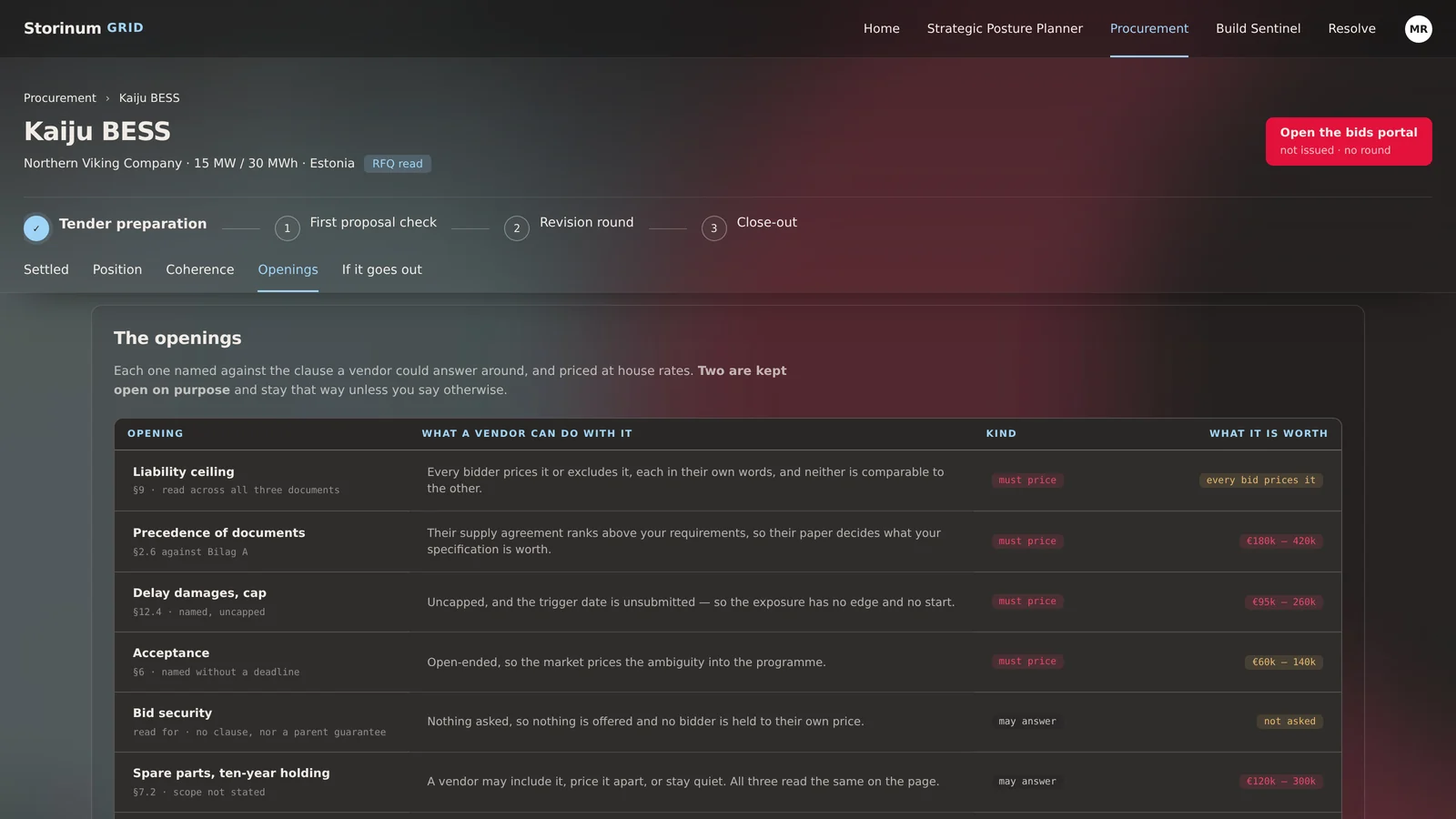
then, when you decide to go further
Procurement
Every offer read as a counter-proposal on what you carry.
A lower number often means a component-only warranty, or a milestone structure left open. Each round asks the same question of every offer: does this hand you back something you meant to transfer, and what does that cost you?
What comes back
Comparability
Every offer restated on the same terms, so price sits against the same scope in each one.
Scores
Price, technical, warranty and delivery scored separately, with the reasoning behind each score.
Risk
What each offer hands back to you, costed, against the clause it comes from.
Position
Every offer plotted against the position you set out with, so you see where signing it would leave you, and the angles to push on before you do.
The rounds
A round is one pass through the vendors: they answer, you see what moved. Run as many as the negotiation needs. The first two are priced by the vendors in the round; close-out is one flat fee at the end of the project.
First proposal check
€250first vendor, then €750 each
The first read across everything that came back. Everything above, on every offer in the round.
OrderRevision round
€1,250per vendor
Vendors answer your revised terms and you see exactly what moved. Run one of these, or run as many as the negotiation needs.
OrderClose-out
€4,000flat
Turns the decision into paper: a contract draft ready to sign, a risk allocation summary, and the documentation a lender or board will ask for.
Every round adds to that vendor’s track record, held alongside the rest of the asset. It carries forward to your next round, and to your next project.
Enterprise
Buying by the project covers one project. Enterprise runs the Strategic Posture Planner, Procurement and Resolve continuously across everything you hold, with one record per asset from the first decision to the last operating year.
Tier 1
Around 5 seats included.
Tier 2 · most common
Around 15 seats included.
Tier 3
Seats scoped to your team.
Each tier includes usage sized for that portfolio’s typical activity, with heavier use billed separately and priced at the call. One record per asset spans every module, so a position written at the planning stage is the one Resolve reads years later. An NDA applies from day one, set once in the master agreement.
We size the tier to your portfolio on the call, against the assets you actually hold.
After you start
01
Three or four real choices on each one — warranty depth, cycling intensity, retention, precedence — with the gain and the trade written on the face of each option, in plain language rather than in a spec sheet.
02
The position moves on the map. The cost band updates. The bankability floor shifts. And where a choice you just made pulls against one you made earlier, that conflict surfaces immediately with a number on it, while it is still cheap to move either way.
03
You know things about this project that live outside the model. Overrule it, and the reasoning you give is recorded alongside the decision. Anything you are unready to settle stays an open item with an owner and a date on it, so it stays a decision rather than a default.
04
Dated and attributed, so the reasoning travels with the decision. The RFQ generates with precedence, liquidated damages and claim windows already written in. The investment brief and the technical brief come out of the same position, which is why all three agree with each other.
01
Different formats, different orders, different words for the same thing. Some answer in a table, some in forty pages of prose, some answer a question you asked in one place and contradict it in another.
02
The same scope, the same assumptions, the same treatment of what each offer leaves open — so when you put the prices side by side, they are prices for the same thing. Silence gets read as an allocation, because that is what it is.
03
Price, technical, warranty and delivery scored separately, each with the reasoning behind the score. Beside them, the risk premium per vendor in euros: what that offer hands back to you, costed against the clause it comes from.
04
An offer is a counter-proposal on what you carry, so accepting one moves you. Every offer is plotted against the position you set out with: how far it pulls you toward carrying the operating risk yourself, how much of the protection you meant to buy survives it, and what that distance is worth in money. Signing becomes a decision about where you end up, rather than about which number is lowest.
05
Specific points to push on with each vendor, and the walk-away position on each one. Their revised terms come into the next round, where what changed is set against what you asked for — so accepting a trade is a decision with a price on it, on the record.

Whenever you want one
Buy any of it and run it yourself if that suits you. And at any point, before or after you have paid for anything, you can put twenty minutes in Oliver’s calendar and walk through your round with him.
Oliver Ruus, co-founder and COO. Fifteen years on infrastructure projects — at a DSO, at an EPC, and on the owner’s side as an investment manager — with procurement run end to end, from vendor RFQ through contract close.
Open at any stage. Same prices either way.
Before you start
These terms govern every account, whether you buy anything or stop after the free step. They are written into the terms and conditions, so they hold as an agreement.
Ownership
Whatever you upload stays your document. Uploading a copy for analysis leaves every right in it exactly where it was.
Where it stays
Your documents and your analysis stay in your workspace, round after round, and stay invisible to the vendors named inside them.
What it is for
Your documents are used to generate your analysis. That is the whole of it.
Support access
Storinum can reach your data for support and dispute resolution. Every access is logged, and you can see the log.
Retention
Documents can be deleted from your workspace whenever you decide, and deletion applies to the analysis generated from them.
Payment
You are invoiced once when you order. Payment by bank transfer within 14 days, in euros. No card is needed and nothing is charged automatically.
What the price covers
Every price on this page includes the European frame — the grid rules and the obligations an owner inside the single market answers to, from procurement through to what a lender asks for in year six. It is in the box, at every tier.
Outside that, or running something the standard frame has yet to cover, get in touch and we work out what it takes.

Everybody we talk to recognises the problem, so the real question is always whether this holds up on their own project. If your market sits outside this frame, or your setup needs the platform bent to fit, ask me and we walk through it on your assets.
Before you buy anything, and after.
Start free
Upload the RFQ you are working on and GRID returns what it settles, what it leaves undefined, and what each gap exposes you to. Nothing goes to a vendor.
For owners running BESS, solar and hybrid projects across Europe.
You have an answer within 24 hours, written by rather than by a queue.