01
The real options, side by side
Three or four choices your team would actually make, each carrying its gain and every give-up it costs. There is a gain on both sides of the call, which is what makes it a call.
For energy asset decisions
GRID runs the decision process behind the calls that move an energy asset's value: the position designed with your team, taken to tender, and held for the asset's whole life. See what every choice costs — in euros, in months, in bidders — before you commit.
A worked asset inside the platform, on sample data. Create an account and it opens.
Three calls before the RFQ goes out
IllustrativeOn these three answers
you carry
transferred
Where the line sits
What changes is that its price is on the table while it is still a decision, and on the record long after it was taken.
You decide
How the asset earns, what it costs to build and to run, what protects it, and where the risk sits.
GRID prices
What each of those decisions costs — and what it would cost to decide the other way.
GRID keeps
Every offer, contract and operating year measured against the position you declared, with the reasoning, in a Vault that is yours.
Every call your team settles lands between earning sooner and lasting longer, and between carrying the risk and paying somebody to take it. Each arrives with its price attached, and together they are your position.
A position you can steer.
Once it is declared, the asset is read against it, and when it moves away from where you put it you see that while it is still a decision.
When the market it was underwritten against moves, it is the whole position that comes up for review, rather than one number inside it.
What that gets you
The Lifecycle Posture Map
Across: whether value comes sooner or the asset stays capable longer. Up: how much of the risk sits with somebody else.
Where the position comes from
Wherever your team leaves one open, it is answered by a party whose interests differ from yours. A blank is an answer with an owner.
Before FID
Whatever the team leaves open, the RFQ freezes on its way out of the door.
At tender
It arrives as a lower number rather than as a labelled risk.
Once running
A warranty becomes claimable once a commissioning baseline exists to measure it against.
Each one reaches you in the open instead, with its price attached. You take it deliberately, and the position stays yours.
Every one of those calls is one gain against a set of give-ups. Every reduction in one exposure is paid for somewhere else — in cost, in years of capability, or in risk you keep yourself.
Money
Priced in euros, on capex and on opex.
Making a performance guarantee claimable adds 2…4% to capex. The price of the gain is stated before you take it.
Life
Priced in years the asset stays capable.
Cycling harder steepens the degradation curve, so the augmentation capex — adding battery capacity later in the asset’s life — arrives more than a year early. The physics decide that, rather than the contract.
Risk
Priced by who ends up liable for it.
Declare the decision and liability follows from it, which makes it a fact about your plan rather than a view on the market.
What GRID does with a call
01
Three or four choices your team would actually make, each carrying its gain and every give-up it costs. There is a gain on both sides of the call, which is what makes it a call.
02
Euros on the capex line, years on the degradation curve, or the party who ends up holding the exposure. They stay apart, because one total would hide all three.
03
Where a figure is missing, GRID says what is missing, why it is missing, and what would settle it. It stays an open item with an owner and a date.
04
Dated and attributed, so the answer is still readable when the same call comes back in year six, and whoever reads it then knows what it was chosen over.
Four outputs, on every call. The arithmetic that makes the options comparable is the part GRID does. The judgement stays where it belongs.
Six of them, and two are the same question eight years apart: how hard to run the asset is settled at design against a model, and comes back in year six against a measurement — read against the answer the first one gave. The last is still a fork. Each arrives with the position it is measured against, and each stays on the record for the one that follows.
In the Strategic Posture Planner, your team settles the three things that decide the return: how it earns, what it costs — to build and to keep running for twenty years — and what protects it. Every trade-off visible, every tension priced, the agreement dated. The RFQ generates from it.
Read more →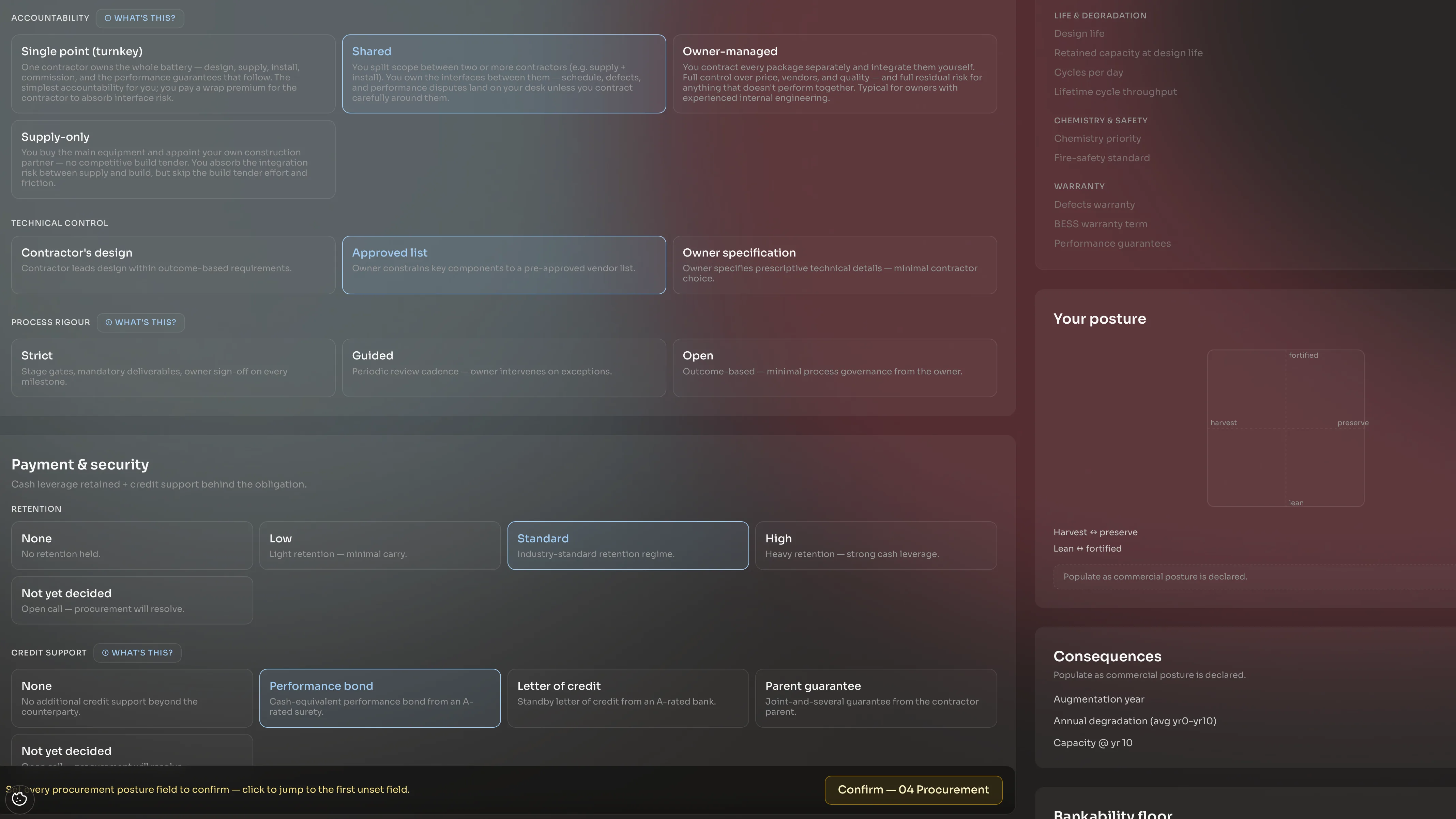
In Procurement, every offer is priced to a comparable lifetime cost — each gap under a headline price flagged and costed. Where the signed contract lands off the design, you chose that gap knowingly, with the number in hand.
Read more →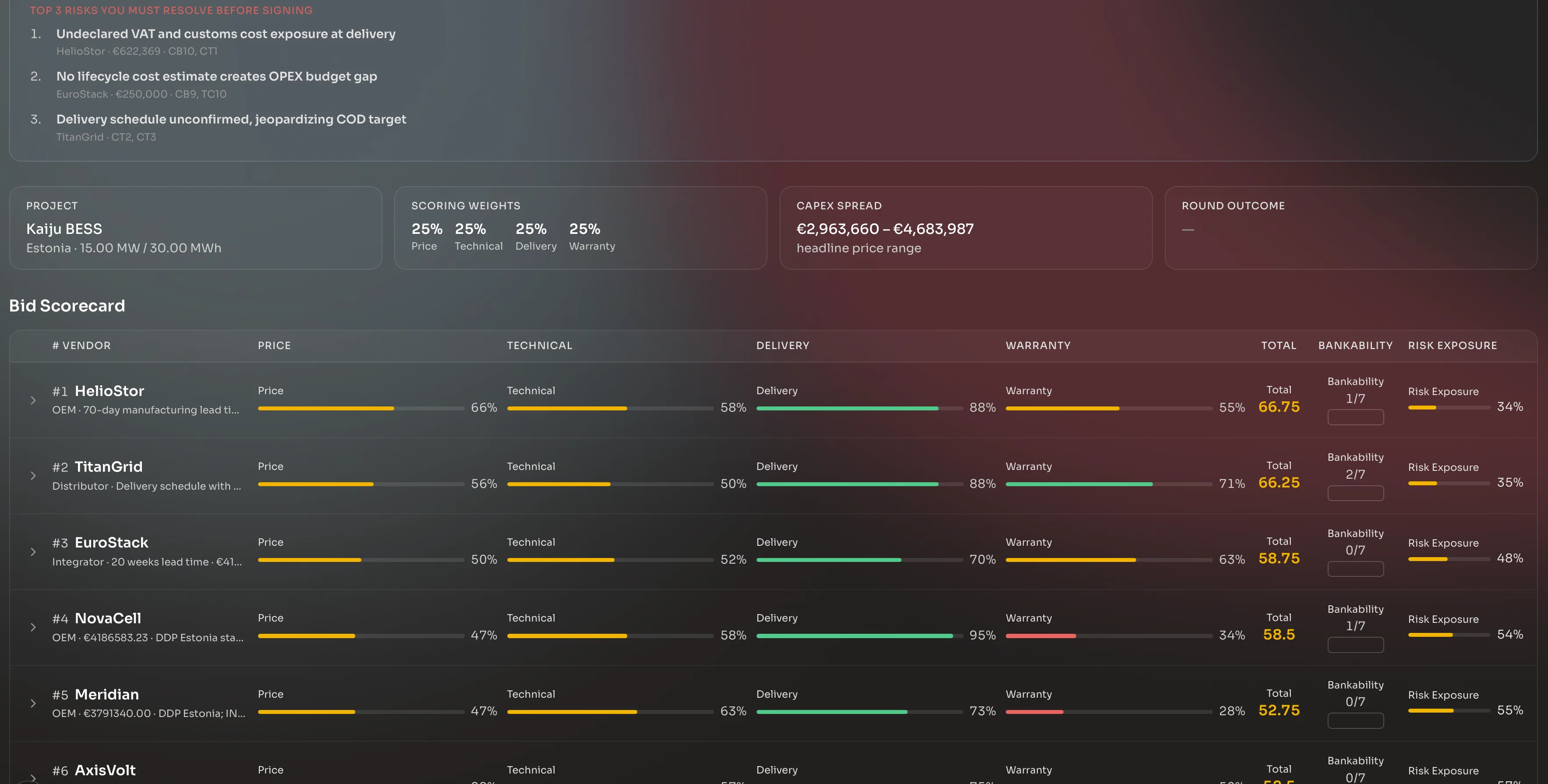
In Resolve, what actually happened is read against what you decided — so drift reaches you while you can still act on it, with the cause named and each option priced. You pick the move; it leaves as work with an owner and a date. For the first time the asset's position is something you steer, rather than something you reconstruct afterwards.
Read more →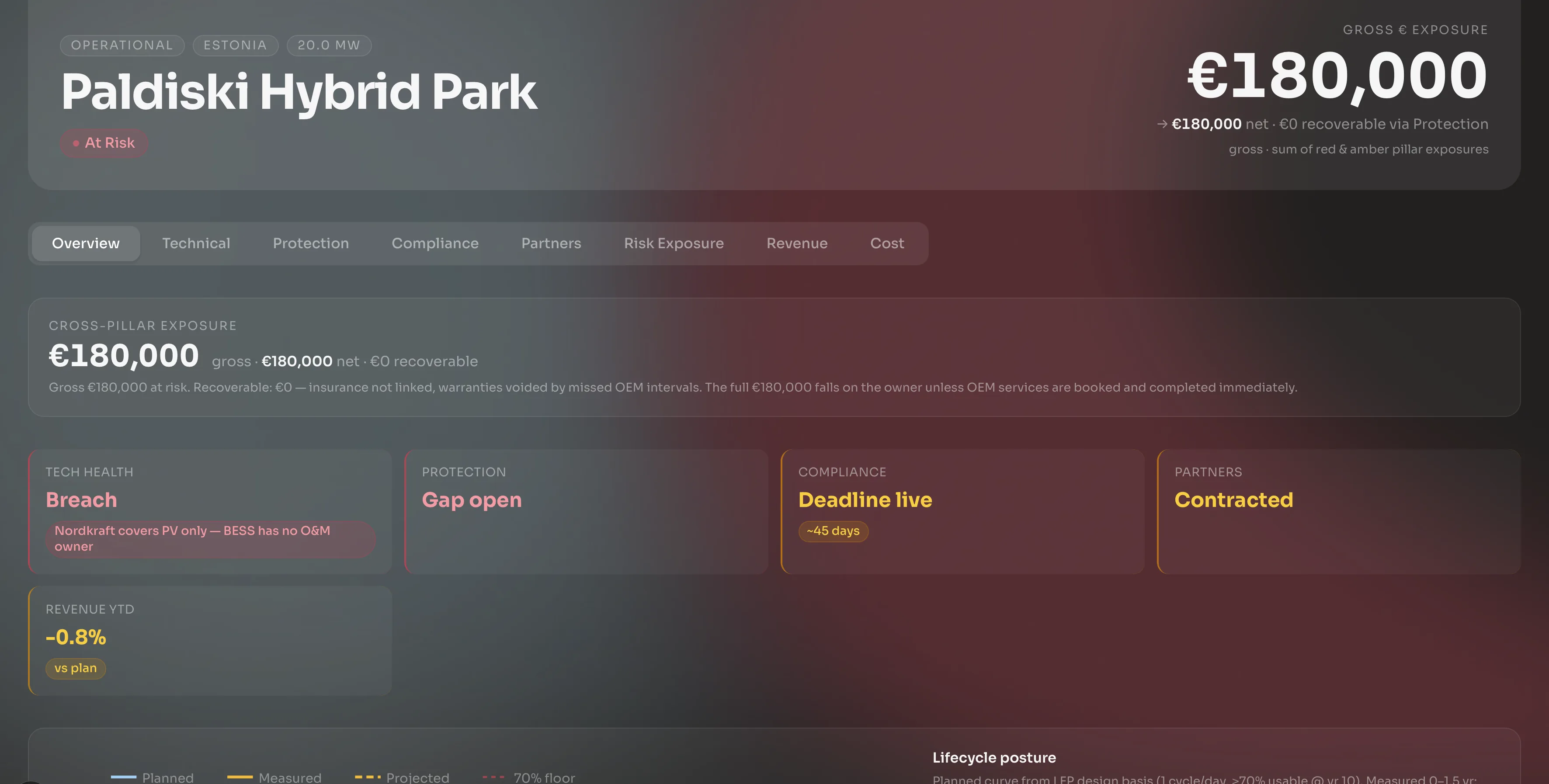
Records Vault
Underneath the modules sits one record per asset. Each module writes into it and reads back from it, so every stage starts from what is already there. It is why a position declared in planning can end, years later, as a claim with a window and a price.
Who is behind it
Renewables are past transition and into growth. Portfolios are scaling faster than the teams running them, and the calls that move real money are still weighed by hand — by eight people who each hold a piece of the same decision, every piece correct on its own terms.
The cost of a call that quietly went the wrong way surfaces long after the people who made it have moved on. We are here because it is a solvable problem that was sitting there unsolved.


The most expensive call on an asset is the one nobody can explain any more. I have watched people rebuild a decision out of email threads, years after whoever made it had moved on. We build this so the answer is simply there when somebody asks.
Before you ask
GRID prices the trade-offs and surfaces what sits inside the terms, so your advisors start with a clearer picture. Drafting and negotiating stay with them.
From your own documents: RFQs, bids, contracts, O&M and performance reports. Every figure carries the page it came from, and a house assumption is labelled as one.
Send one RFQ, tender package, or asset, and you see what is in it before anything becomes a commitment. Pricing beyond that scales with the assets under management.
They stay inside your own workspace and stay invisible to the vendors named in them. They are used to generate your analysis, and you can delete them whenever you decide.
Something else on your mind?
Start where you are
Before FID
Bring the seats — technical, legal, commercial — and settle the RFQ before it goes out.
Live RFQ
Bring your actual RFQ. Your structure and your shortlist stay inside your own workspace.
Post-COD
Send one asset and see where it stands against what was signed for it.
One asset is enough to start. What your team decides is priced as it is decided, and the reasoning stays readable for whoever picks the asset up long after.
You have an answer within 24 hours, written by rather than by a queue.